

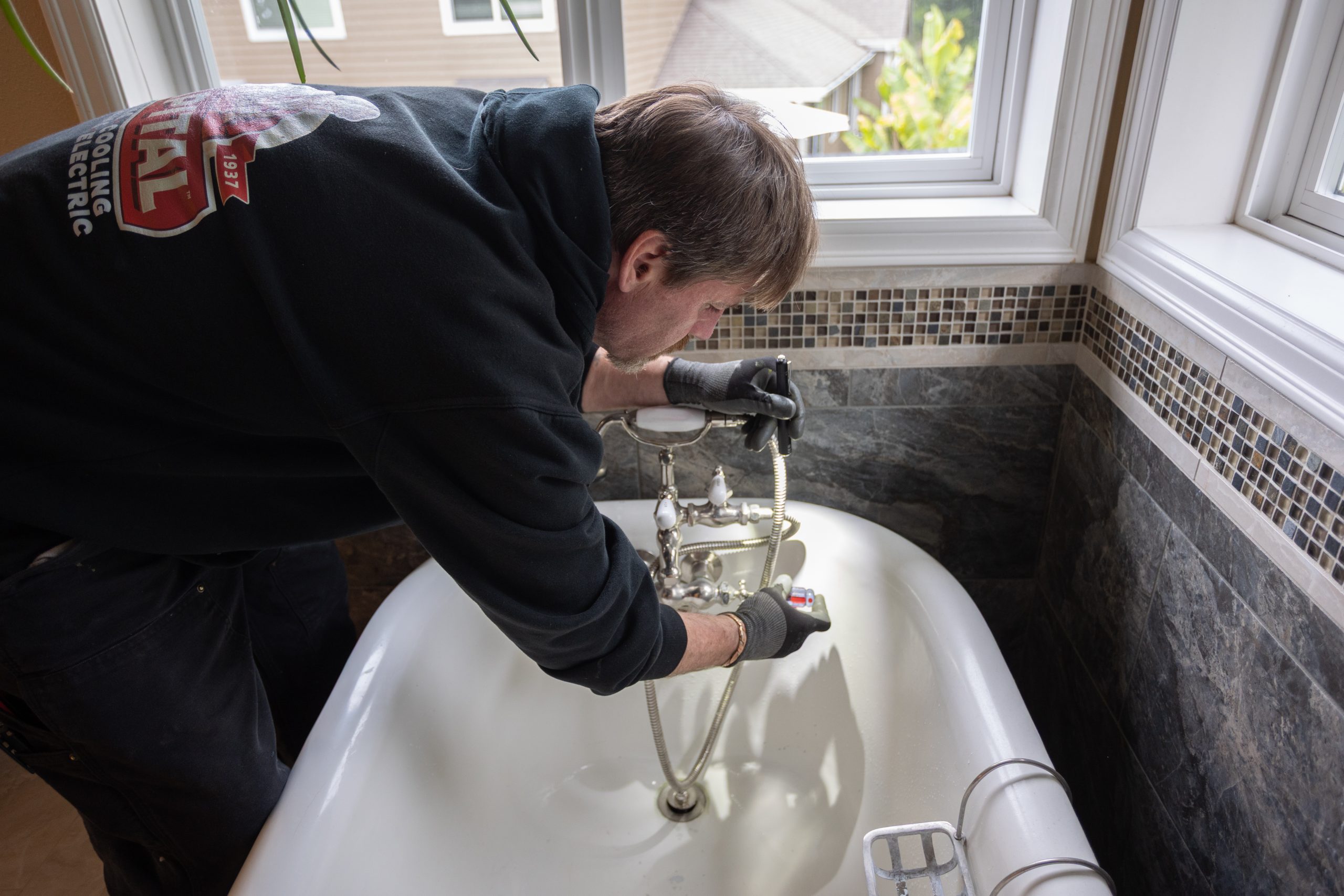
When you have your plumbing inspected, a licensed plumber will perform a top-to-bottom review of your entire plumbing system.
What kind of home plumbing inspections does a plumber provide?
Home services businesses perform certain types of inspections, but not others:
Plumbing inspections for real estate transactions? No. Home services companies like ours typically do not provide plumbing inspections connected with home sales. These types of inspections are performed by home inspectors.
Repairs in response to inspections connected to home sales? Yes. Local plumbing providers can make repairs or corrections at the request of home buyers that are based on home inspection reports. When we do a home inspection repair, we will also report on anything we see that the home inspector might have overlooked. If we see any code violations or issues that need to be addressed immediately, we will include our observations in our report.
Routine plumbing inspections to maintain plumbing systems? Yes! That’s our wheelhouse. For customers who are part of our company’s Comfort Care Maintenance Plan, we schedule a plumbing inspection around the end of the first year of membership. (The program includes an electrical inspection and yearly HVAC inspection and tune-up, too.)
Tom Redding, our lead plumber, recommends a yearly plumbing inspection, especially if you have an older home. Here’s what to expect.
Inspecting The Plumbing Outside Your Home
Water pressure. Your plumber will begin by taking a water pressure reading to see if it’s too high, too low, or just right. In general, recommended water pressure should range between 40 and 80 pounds per square inch (psi), with an ideal around 60 psi.
Water pressure exceeding 80 psi can lead to leaks or increased wear and tear on plumbing and faucets. If it dips below 40 psi, water pressure will be insufficient for showering, washing hands, and other daily activities.
High water pressure is a little like high blood pressure; over time, high water pressure will cause a failure, such as a burst water line or ruined interiors of faucets or valves, just as high blood pressure can cause damage to your heart and circulation system over time if it goes unaddressed.
A water pressure of 80 psi or more requires the installation of a pressure-reducing valve. If a system has water pressure lower than 15 psi, a booster is required to maintain a sanitary system.
Hose bibs (exterior faucets). We will also inspect the condition of all hose bibs—the faucets on the exterior of your house—to make sure they don’t have any cracks, leaks, damage from freezing weather, broken vacuum breakers, or handles that are malfunctioning.
Water meter. Your plumber will inspect your water meter by asking you to turn off all water at the house. If a dial indicator moves while water use inside the house is idle, this indicates “either a leak at the water meter, a leak on the main between the water meter and the house, or a leak inside the residence.”
Inspecting The Plumbing Inside Your Home
Overview of your plumbing system. Your plumber will walk through your home, inspecting every aspect of the plumbing system that is visible. “We look at the angle stops, we look at the connections, we look at the trap,” Tom tells us. We also take photos of under-sink areas to verify that all plumbing terminations are solid.
Water heater. The life expectancy of a standard residential water heater is 10-15 years. During your plumbing inspection, your plumber will verify the age of the water heater and check to make sure it’s installed correctly. We will also check your thermal expansion tank, if you have one, to make sure it’s not waterlogged or ruptured.
Washing machine hoses. Your plumber will visually inspect the hoses that run to and from your clothes washer to make sure they’re intact and in good working order.
Dishwasher. Since dishwasher plumbing is concealed inside the appliance and behind cabinetry walls, we aren’t able to inspect every part of the plumbing connected to your dishwasher directly. However, we will check plumbing terminations beneath the kitchen sink, which is typically adjacent to the dishwasher, to make sure there are no leaks, from the dishwasher or otherwise.
Faucets and drains. “We also verify the drains,” Tom says. “We fill up the sinks, the tubs, and the showers and we verify that everything is draining properly. It’s common to find a slow-draining sink or tub during these inspections. When we do, we offer to clear the drain on the spot. If we find something more complicated or extensive, like a fixture replacement, we offer to get a replacement on the schedule.
Post-Inspection Options
No matter what the results, we discuss our findings and possible solutions with you as the homeowner. Our goal is to help you ensure that your entire plumbing system is in good working order.
If we can fix a problem on the spot, we will offer to do so. Quick fixes include clearing clogged or slow-draining sinks, replacing standard hoses, and cleaning out faucet heads.
If you need a leak fixed, a faucet replaced, or a more serious loss of water addressed, we will let you know how we would approach and fix the problem and connect you with our scheduling department if you’d like to hire us to do the job.
SOURCES
How to Read a Water Meter and Check for Leaks, mountainview.gov (accessed March 29, 2026)
WAC 51-56-0400: Chapter 4—Plumbing fixtures and fixture fittings, https://app.leg.wa.gov (accessed March 30, 2026)
What Should Household Water Pressure Be: A Guide to Optimal Levels, pacificbackflow.com (accessed March 29, 2026)
Our Expert
This post is based on an interview with Tom Redding, the lead plumber for Capital Heating, Cooling, Plumbing & Electric. He has more than 30 years of experience in the pipe trades. In addition to repairs, he designs and installs complex plumbing and mechanical systems. Tom reviewed and approved this post.
Our Company
Capital Heating, Cooling, Plumbing & Electric has been serving the South Sound in Washington state for three generations. Our highly trained technicians deliver top-notch service and the latest in home systems innovations.