

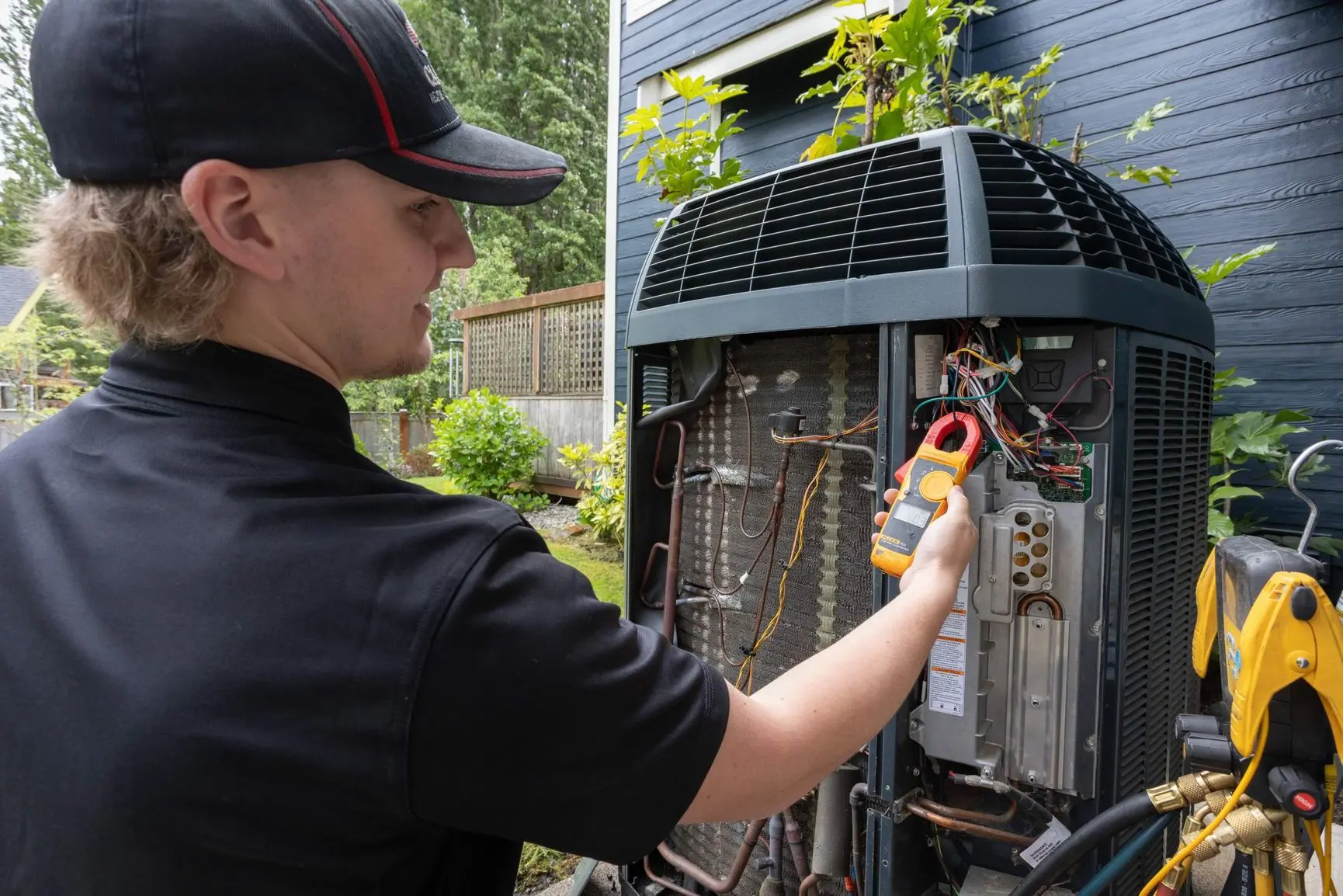
Summers are hotter now than they have been in the recent past, which has led to more and more households and businesses in the Pacific Northwest adding air conditioning.
These systems are important for safety in extreme heat and for comfort in the middle of the summer. They can also improve air quality and keep you safe indoors during fire season.
But they aren’t set-it-and-forget-it systems. They need to be maintained and the filters need to be changed regularly. Let’s take a closer look at what your cooling system does, what it doesn’t do, and the steps you can take to make the air in your house as safe and clean as possible.
What Your Cooling System Does
Your cooling system cools the air inside to a livable temperature. This is important for the comfort of people and pets and for productivity. When it’s comfortable indoors, you can carry on with the things you normally do indoors (no one can manage day-to-day tasks in sweltering heat).
Cooled air becomes a matter of health and safety for very young children, elders, and people with certain medical conditions. It’s a matter of safety for everyone when our area experiences extreme weather, such as a heat wave or heat dome (some experts dispute the latter term).
There are two side benefits to a cooling system, things that probably weren’t top-of-mind when you purchased the system.
The first is that it functions as a dehumidifier. Lower humidity amplifies the effect of cooled air.
Your system also filters the air, removing pollutants and particles such as dust, lint, pollen, and smoke.
What Your Cooling System Does Not Do
An air conditioner does not purify the air. However, you can add on a whole-house air purifier to your system. Scroll down to read more on this.
Your system does not mechanically bring in fresh air. Heating and cooling systems are designed to heat or cool, move, filter, and dehumidify air that is already in the house or building. Bring fresh air into the house by opening doors and windows on days when outdoor air quality is good.
How Can You Improve Your Indoor Air Quality?
Just because your cooling system can improve your indoor air quality doesn’t mean it will. Do your part to attend to indoor air quality and maintain your system—including changing or cleaning filters on a good schedule—and you can make the air inside healthier and safer.
Improve Your Filtration
Maintaining your filters is probably the most important aspect of leveraging your heating or cooling system to improve air quality.
When your filter fills up, it stops filtering air properly, simply because it’s too clogged to capture any more particles. This can actually work against you by actively making air quality worse. Poorly maintained systems and dirty filters have been linked to poor health conditions and exacerbation of particular illnesses.
Combat this by changing your replaceable filter or cleaning your permanent filter on a regular schedule. Go with the manufacturer’s recommendation. In general, thinner filters need to be replaced more often. You also need to replace them more often if you have pets that shed, during fire events, or during periods of poor outdoor air quality.
Read more about replacing or cleaning your specific type of filter here.
It’s also important to upgrade to the highest quality filter your system can accommodate. Find out what minimum efficiency reporting value (MERV) rating your current filter has and install a higher-grade one. If possibly, instal a MERV 11 or MERV 13 filter.
You can also increase the efficacy of your system’s air filtration by having your heating or cooling system maintained regularly. This ensures that filters are installed, cleaned, and maintained properly and that nothing about the way your system is operating is hindering its filtration function.
Identify Indoor Pollution Sources
Sources as versatile as household cleaning products, personal care products, new carpet or flooring, humidifiers, cigarettes and other tobacco products, older gas cooktops, or pesticides tracked indoors can pollute the air in your home.
One way to improve your indoor air quality is to find sources that are or have the potential to contaminate the air and either eliminate or isolate them.
Replace cleaning and personal products with options that have fewer strong odors or make sure you’re running an exhaust fan or opening windows near the place where you’re using them.
Air out the house after you’ve had flooring or cabinets replaced or during and after a renovation or addition.
Clean and disinfect humidifiers after each use and air out the room where they were being used.
Use tobacco products outside or move air through rooms where it’s been used by opening windows and doors and using fans.
Make sure your gas cooktop or stove is adjusted so noxious gas doesn’t leach into your kitchen.
Remove shoes indoors if you’ve been walking on treated areas, such as lawns.
Improve Your Ventilation
You can dilute the concentration of air pollutants indoors simply by bringing more fresh air inside.
Since the vast majority of home heating and cooling systems do not bring in fresh air, it’s helpful for indoor air quality to open windows and doors on a pleasant day when outdoor air quality is good.
If you have a window air conditioning unit, you can also run it with the vent open to move outside air indoors. Run kitchen and bathroom exhaust fans to move damp or smoky air outside.
If you’re painting or using other strong substances indoors, it’s important to ventilate the area well to move fumes and particles outdoors. Keep windows open and use fans to actively move contaminated air outside and fresh air inside.
Keep Humidity In Check
According to a study published in Environmental Health Perspectives, “The indoor size of allergenic mite and fungal populations is directly dependent upon the relative humidity. Mite populations are minimized when the relative humidity is below 50% and reach a maximum size at 80% relative humidity. Most species of fungi cannot grow unless the relative humidity exceeds 60%.”
The abstract also notes that indoor humidity “affects the rate of offgassing of formaldehyde from indoor building materials” as well as the formation of ozone and concludes that “[t]he majority of adverse health effects caused by relative humidity would be minimized by maintaining indoor levels between 40 and 60%.”
To test your indoor humidity, you can conduct an ice cube test: Fill a glass with ice cubes and water. After three or four minutes, check to see if condensation is forming on the outside of the glass. If it is, it indicates that humidity levels inside are high. If not, it indicates that they’re low.
To find the exact humidity reading, you can use a hygrometer or contact a professional, who can also help you figure out how to raise or lower the relative humidity inside. Since we live in a wet climate in the Pacific Northwest, the solution may include use of a dehumidifier.
Add A Whole-House Air Purifier
You can also invest in a whole-house air purifier. These devices integrate with your system and to add a layer of protection by eliminating bacteria and other harmful pollutants.
Air purifiers can accommodate filters with higher MERV ratings, use HEPA filters, or use ionization technology to help get rid of bacterias and viruses as well as gases and odors.
Sources
Healthier Home, Asthma and Allergy Foundation of America (accessed March 28, 2026)
How To Use An Ice Cube To Measure Your Home’s Humidity Level This Summer, housedigest.com, Charlotte Sears, February 19, 2024 (accessed May 29 2026)
How Your AC Can Enhance Indoor Air Quality, Tadiran, August 30, 2023 (accessed March 28, 2026)
Improving Indoor Air Quality, United States Environmental Protection Agency (accessed May 27, 2026)
Indirect health effects of relative humidity in indoor environments, Environmental Health Perspectives (Abstract), A.V. Arundel, E.M. Sterling, J.H. Biggin, T.D. Sterling, March 1986
Indoor Air Quality Strategies for Air-Conditioning and Ventilation Systems with the Spread of the Global Coronavirus (COVID-19) Epidemic: Improvements and Recommendations, Environmental Research (Volume 199), Ashraf Mimi Elsaid and M. Salem Ahmed, August 2021
Is ‘heat dome’ overhyped? Why some meteorologists dislike this term, Yale Climate Connections, Bob Henson, August 1, 2025 (accessed May 29, 2026)
Why You Really Need to Change Your Air Conditioner’s Filter, Time, Jaime Ducharme, July 7, 2023 (accessed May 27, 2026)
Our Company
Capital Heating, Cooling, Plumbing & Electric has been serving the South Sound in Washington state for three generations. Our highly trained technicians deliver top-notch service and the latest in home systems innovations.